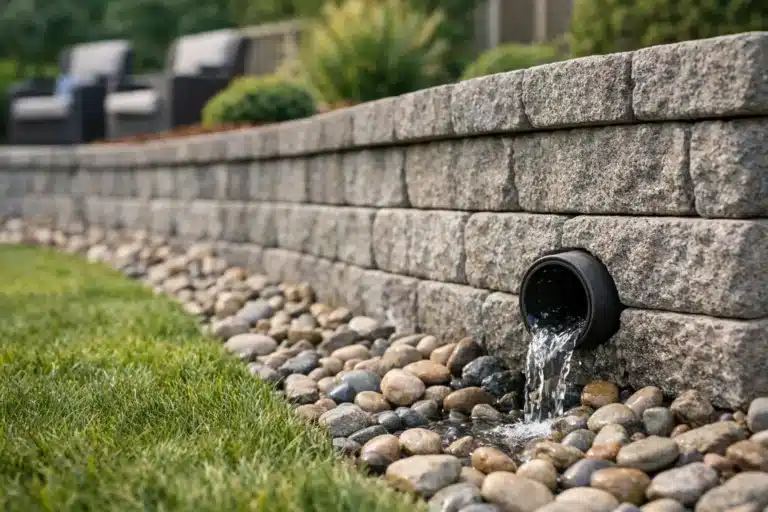

A wall can look solid from the driveway and still be three winters from failing. Most of what goes wrong happens out of sight, behind the stone, which is why retaining wall maintenance is less about cleaning the face and more about keeping water moving away from the structure.
Walls in Waterloo Region work harder than walls in milder places. Ground freezes, thaws, and freezes again, and every cycle pushes on anything holding back soil. A wall that drains properly shrugs this off for decades. A wall that does not will lean, bulge, and eventually come apart – usually starting somewhere you cannot see until the movement reaches the surface.
Why Ontario Retaining Walls Fail
Almost every failed wall we are called to look at failed for the same reason: water got behind it and could not get out. Saturated soil is dramatically heavier than dry soil, and when that water freezes it expands, pushing the wall outward with enormous force. Do that a few dozen times over several winters and even well-laid stone starts to move.
The stone itself is rarely the problem. Block and armour stone both handle Ontario winters without complaint. What fails is the drainage behind the wall, the base underneath it, or the backfill that was never compacted properly in the first place. That is why maintenance focuses on the things you cannot see.
Inspect Twice a Year
Two walks a year catch nearly everything while it is still cheap to fix. Do one in spring once the ground has thawed, and one in autumn before the first hard freeze.
Stand at one end and sight along the face. A wall should read as a straight line or a consistent curve. What you are looking for is any section that has moved away from that line – a bulge, a lean, or a course that has shifted forward relative to the one below it. Small deviations are worth noting and watching. A bulge that grows between spring and autumn is telling you something is actively wrong.
Then check the joints. Gaps opening between blocks, or stones that have rotated slightly, both indicate movement. Look at the cap course as well, since caps are usually the first thing to shift and the easiest thing to reset before the problem spreads.
Drainage Is the Whole Job
If you only maintain one thing, maintain the drainage.
A properly built wall has clear stone behind it, filter fabric separating that stone from the soil, and a perforated pipe at the base running to somewhere the water can escape. That outlet is the part that needs attention. Find where it daylights and make sure it is not buried under mulch, blocked by soil wash, or grown over. A drain that cannot discharge is the same as no drain at all.
Also watch what happens above the wall. Downspouts that discharge onto the slope behind a retaining wall are one of the most common causes of premature failure we see. Every heavy rain sends concentrated water straight into the soil the wall is holding. Extending that downspout past the wall, or tying it into a proper drain line, costs very little and removes a large part of the load.
After heavy rain, look for water seeping through the face or pooling at the base. Either means water is finding its way through the structure rather than around it.
Vegetation and What to Plant
Roots and retaining walls are a poor combination. Shrubs and trees planted close behind a wall send roots into the backfill, and as those roots thicken they exert steady pressure on the stone. Woody growth in the joints does the same thing on a smaller scale.
Pull anything growing directly out of the wall face as soon as you see it. Keep larger plantings back from the top of the wall, and favour shallow-rooted perennials and groundcovers near the structure. Grass and low planting immediately behind a wall are fine and actually help by holding the surface soil in place.
Cleaning Without Causing Damage
Stone picks up algae, efflorescence and general grime over time, particularly on the shaded north face. This is cosmetic and can wait for a dry stretch in spring.
Use a stiff brush and water. If you use a pressure washer, keep it on a wide fan setting and well back from the surface – a narrow jet at close range strips the surface off block and blasts jointing material out from between stones, which does real harm in pursuit of a cosmetic result. Efflorescence, the white powdery bloom that appears on new block, generally weathers off on its own within a couple of seasons.
When Maintenance Becomes a Rebuild
Some things are worth calling someone about rather than watching another season.
A wall leaning noticeably outward, a bulge that has visibly grown, courses that have separated, or a section that has dropped relative to its neighbours all point to a structural problem rather than a maintenance one. So does soil disappearing from behind the wall, or a hollow developing at the top, both of which mean fill is washing out through the structure.
The honest position is that a wall with a base or drainage failure cannot be maintained back to health. The failure is underneath. Resetting the visible courses without addressing what is beneath buys a season or two and then the same movement returns. In that situation the useful question is not how to patch it but whether the wall gets rebuilt properly.
Walls above four feet are engineered structures, and a permit is required over 3.3 feet (1 meter), which is worth knowing before any rebuild is contemplated – it changes both the timeline and the cost.
A Realistic Maintenance Routine
For most residential walls the whole thing takes under an hour a year. Sight along the face each spring and autumn and note anything that has moved. Clear the drain outlet and check it runs. Pull vegetation out of the joints. Make sure downspouts and surface water are directed away from the top of the wall. Brush the face down when it needs it.
That is genuinely most of it. Retaining wall maintenance is not demanding work, but it is the difference between a wall that lasts thirty years and one that needs rebuilding in eight.
If a wall on your property has started to move, or you would like a straight answer on whether it needs maintenance or replacement, we cover Kitchener, Waterloo and Cambridge and the on-site assessment is free. You can read more about how we build retaining walls, or see what a new wall costs on our retaining wall cost page.